Long-term Athlete Development

What is Athletic Development?

INTRODUCTION
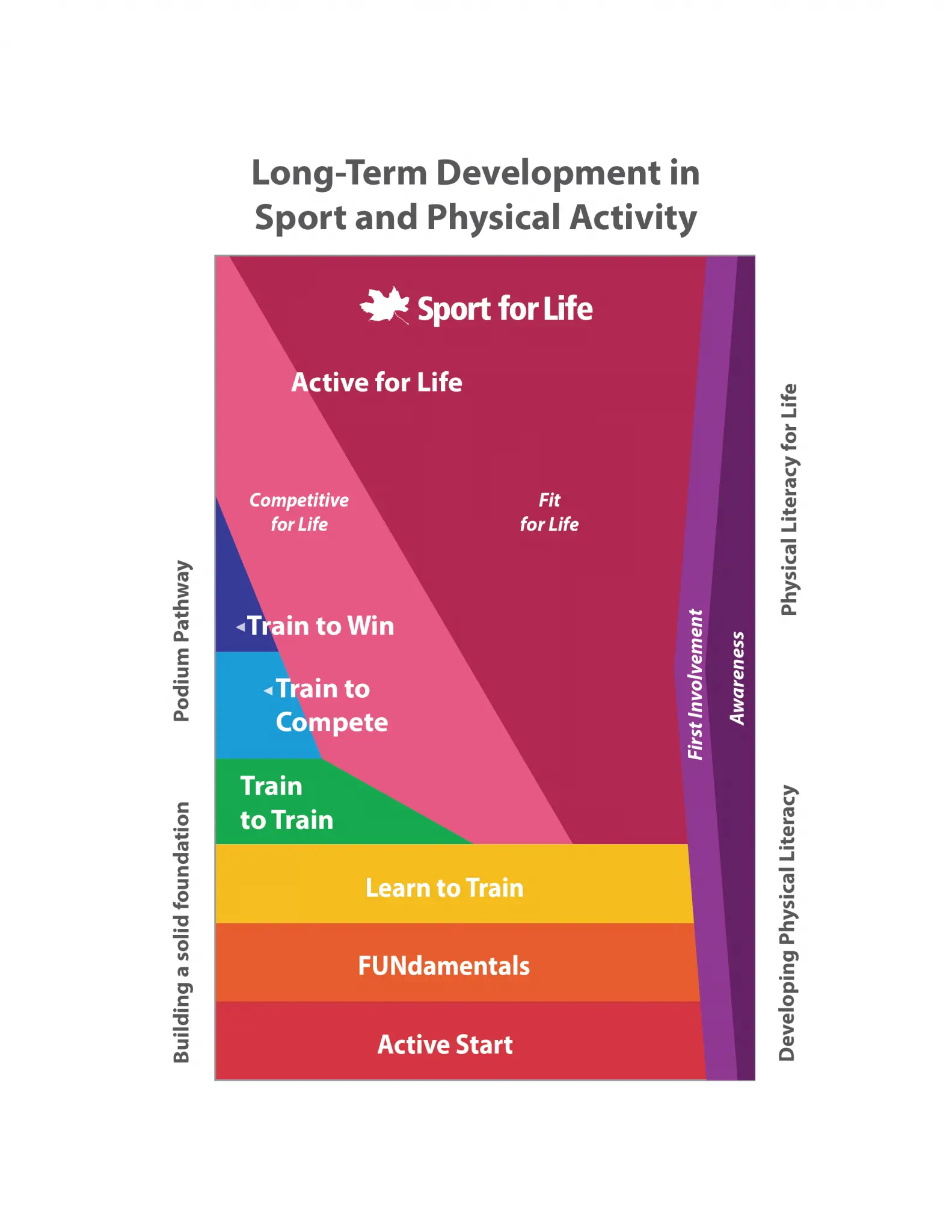
In order to understand the athlete development matrix, one must have an understanding of the LongTerm Development in Sport and Physical Activity Model, formerly referred to as Long-Term Athlete Development Model (LTAD). In the current version of the model, Higgs, Way, and Harber (2019) state, “Long-Term Development in Sport and Physical Activity is a framework for the development of every child, youth, and adult to enable optimal participation in sport and physical activity. It takes into account growth, maturation and development, trainability, and sport system alignment”.
FIRST INVOLVEMENT & AWARENESS
“First Involvement and Awareness are integral components of everyone’s initial experiences in sport and physical activity. Physical literacy, while vital during the early stages, is not confined to the early stages—it can and should continue to be developed throughout the life course. The Podium Pathway describes the sport-defined excellence stages of Long-Term Development in Sport and Physical Activity and specifically applies to athletes on a trajectory toward podium results at the highest level of their sport. The updated rectangle reflects these changes.” (Long-Term Development in Sport and Physical Activity 3.0, Sport for Life, January 2019).
ACTIVE START
Swimming is unique in that it is the only sport that does not have direct responsibility for first involvement and awareness at the Active Start phase of development. Compared to other sports found in the Canadian sport system, Swimming Canada is the only Canadian sport that does not have direct responsibility for teaching the fundamentals of the sport to young children. Basic teaching is undertaken by organizations with a primary mandate of child safety, and learn to swim programs are mostly operated by Red Cross of the Royal Lifesaving Society. Swimming Canada has partnered with the Red Cross and Lifesaving Society in program design and development, but leaves delivery to them. Children identified as having swimming potential are frequently encouraged to join a swim club – often operating out of the same facility – in order to advance in their sport. Children learn to swim during the Active Start or FUNdamentals stages of athlete development and most often enter swim clubs at the upper end of FUNdamentals, around 8 or 9 years of age.
FUNDAMENTALS (FUN) AND LEARN TO TRAIN (L2T)
Most clubs across Canada offer programs that provide swimming to children covered by these 2 stages of Athlete Development. The FUNdamentals stage is an important introduction to the sport. This stage will introduce basic movement skills, agility, balance and coordination. The Learn to Train stage will provide increasingly challenging and progressive experiences.
TRAIN TO TRAIN (T2T), TRAIN TO COMPETE (T2C), AND TRAIN TO WIN (T2W)
The work of the National Program in Swimming Canada is focused around these 3 main stages of athlete development. Particular attention is placed on the Train to Compete and the Train to Win stages of the process, which we refer to as the Podium Pathway.